Tag: Crime Thriller

Crime thrillers are often built around detectives, investigations, and the pursuit of justice after a crime has already been committed. The works gathered here move beyond those familiar patterns to examine the deeper systems surrounding crime—institutions that shape investigations, pressures that distort truth, and the quiet calculations made by those operating on both sides of the law. These stories reveal how crime rarely exists in isolation. It grows out of power, loyalty, ambition, and the structures that quietly allow certain actions to happen while others are pursued.

Authors Like

Authors Like Robert Mason

authors like robert mason hero image of Huey pilot in the jungle chaos

Readers searching for authors like Robert Mason are not looking for heroic war stories or cinematic combat fantasy. They’re looking for what it feels like to live inside a military machine the pressure, the boredom, the procedures, the fear, and the quiet psychological cost that accumulates between missions.

That’s exactly the territory my award winning novel, Snodgrass occupies.

Why readers search for Robert Mason

Robert Mason’s Chickenhawk remains one of the most respected military memoirs ever written because it strips war of mythology and replaces it with experience.

Readers come to Mason for:

  • First-person military realism
  • Procedural detail that creates credibility
  • Stress embedded in routine, not just combat
  • The mental toll of repeated missions
  • A narrator who doesn’t posture or editorialize

Mason doesn’t write about war as spectacle.
He writes about living inside it.

Where Snodgrass belongs in that lineage

Like Mason, Snodgrass is grounded in daily military life, not isolated heroics.

Carrier operations.
Maintenance hangars.
Ops rooms.
Briefings.
Paperwork.
Waiting.

Combat matters—but it’s framed correctly: as one pressure among many.

In Snodgrass, tension builds through:

  • Constant readiness
  • Bureaucratic friction
  • Chain-of-command dynamics
  • Aircraft limits and mechanical risk
  • The body reacting before conscious thought

The result is the same immersive realism Mason readers recognize immediately.

Aviation realism without romance

Mason’s helicopters in Vietnam were unforgiving machines.
Snodgrass treats fighter aircraft the same way.

Jets are not symbols of freedom or dominance.
They are systems with margins—and exceeding those margins has consequences.

The flight sequences in Snodgrass emphasize:

  • Situational awareness under saturation
  • Reflex overtaking deliberation
  • The thin line between control and catastrophe
  • How training surfaces when thinking is too slow

This is aviation written for readers who know the difference between fantasy and flight.

The key difference—and why it strengthens the book

Where Robert Mason focuses primarily on the psychological erosion caused by sustained combat, my novel Snodgrass expands the lens.

The book places military life alongside:

  • A criminal survival past
  • Institutional bureaucracy
  • Authority as procedure rather than personality

This contrast sharpens everything.

The narrator understands systems not just as a soldier, but as someone who learned—early—how rules are enforced, ignored, or exploited depending on context.

That layered awareness gives Snodgrass a perspective Mason readers often appreciate once they encounter it.

Stress isn’t loud. It’s constant.

One of the strongest parallels between Mason and the novel Snodgrass is tone.

There’s no melodrama here.
No artificial bravado.
No inflated stakes.

Instead, stress accumulates through repetition:

  • drills that might become real
  • missions that could escalate
  • authority that speaks calmly while holding power

This is how military pressure actually works—and why Mason’s readers trust it when they see it again.

Who should read Snodgrass

You’ll want this book if:

  • You value military memoir grounded in routine and realism
  • You appreciate aviation written with technical respect
  • You’re drawn to first-person narratives that don’t romanticize service
  • You want to understand how systems shape people over time

If Chickenhawk showed you the cost of flying combat missions, Snodgrass shows you the cost of living inside the structure that demands them.

A final word for authors like Robert Mason readers

Robert Mason wrote about surviving war.
Snodgrass writes about surviving institutions—military, economic, and personal.

Different conflicts.
Same honesty.

If you’re searching for authors like Robert Mason because you want truth without myth, Snodgrass belongs on your list.

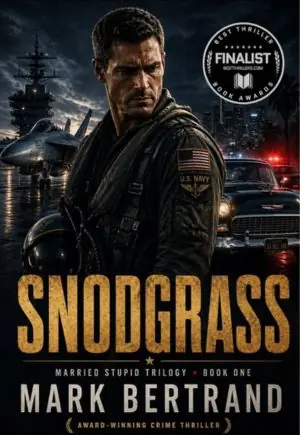
SNODGRASS book cover image of a naval aviator, aircraft carrier, f18 hornet, a sweet 1955 Chevy Belair and a cityscape

Snodgrass | Married Stupid

Authors Like Michel HouellebecqAuthors Like Don WinslowAuthors Like Neal Stephenson

Book Finder Your Next Great Read using my AI tool

Follow me on Bluesky

project 2029. image leads to stories that provide the codes and the 15 key letters. If you know where to look you can find them all.

Authors Like

Authors Like Michel Houellebecq

Authors Like Michel Houellebecq - Psychological Thriller Novels by Mark Bertrand, moody European psychological-thriller image of a solitary man in a dim café, beer and cigarettes on the table, staring through a rain-streaked window at a bleak cityscape

Readers searching for authors like Michel Houellebecq are not looking for provocation or satire. They’re looking for an unblinking account of modern life stripped of consolation, where belief systems fail quietly, and meaning erodes without spectacle. That’s the terrain my novel Bertrand occupies.

Why readers search for Michel Houellebecq

  • Disenchantment treated as a condition, not a phase
  • Societies that function while hollowing out the people inside them
  • Men observing their own moral and emotional attrition
  • Institutions that replace intimacy, belief, and purpose
  • A refusal to offer transcendence as an escape
  • Narratives that document decline without dramatizing it

Houellebecq doesn’t shock. He records.

Start with BERTRAND.
If you read Michel Houellebecq for bleak clarity, moral erosion, failed belief, and the cold machinery of modern life, BERTRAND is the Mark Bertrand novel written for that reader. It is a psychological crime thriller about institutional pressure, hidden power, spiritual exhaustion, and the cost of surviving systems that keep functioning long after meaning has died.

Read BERTRAND by Mark Bertrand.

Where Bertrand fits this lineage

The novel Bertrand shares Houellebecq’s commitment to clarity over comfort. The novel treats systems—economic, ideological, spiritual—as environments that shape interior life whether acknowledged or not.

The overlap appears in:

  • Characters conscious of their own erosion
  • Social structures that persist despite their emptiness
  • A worldview that does not confuse insight with salvation
  • Psychological pressure generated by recognition, not surprise

Like Houellebecq’s work, the book assumes awareness does not equal escape.

The key difference—and why it matters

Where Michel Houellebecq focuses on cultural and sexual desiccation, my novel Bertrand places that experience alongside financial, legal, and institutional domination.

The axis shifts from social collapse to operational survival. The question is not how meaning disappears, but how a person functions once its absence becomes permanent.

The Mark Bertrand Novel for Michel Houellebecq Readers

BERTRAND by Mark Bertrand

For readers who want fiction without consolation.
For readers who care about systems, despair, compliance, and the quiet destruction of the self.
For readers who want a thriller that does not blink.

Houellebecq shows the exhaustion of meaning.
BERTRAND shows what it costs to keep living inside the structures that replace it.

This is not satire.
This is not performance.
This is pressure, erosion, compromise, and survival.

Buy the ebook for $4.99.
Buy the paperback for $19.99

No irony. No performance.

There is no posturing.
No ideological theater.
No invitation to feel superior to the collapse being described.

The tone remains direct and unsentimental. Observations stand on their own. The narrative does not ask the reader to agree—only to recognize.

Who should read the novel Bertrand

This book is for readers who:

  • Tolerate bleak clarity without outrage
  • Are interested in systemic explanations of despair
  • Prefer diagnosis to satire
  • Read for recognition rather than release

If that sounds like you, then BERTRAND is the Mark Bertrand novel you should read first.

This is for readers who do not need comfort.
This is for readers who want diagnosis, not reassurance.
This is for readers who understand that modern systems do not collapse first. They hollow people out first.

Read BERTRAND now.

A final word for authors like Michel Houellebecq readers

Authors like Michel Houellebecq write about the exhaustion of meaning.
Authors like Mark Bertrand write about what replaces it.

Both understand that modern systems do not need belief to function—only compliance. For readers drawn to Houellebecq’s clinical honesty about contemporary life, Bertrand extends that examination into the machinery that makes such emptiness sustainable.

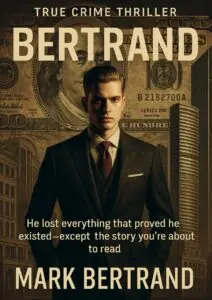
Bertrand book cover image authors like william gibson

Buy the ebook for $4.99.
Buy the paperback for $19.99

Authors Like

Authors Like James Ellroy

Authors Like James Ellroy - Psychological Thriller Novels by Mark Bertrand, gritty noir crime-thriller image with a vintage typewriter, confidential case files, revolver, whiskey glass, police tape, flashing patrol car, and blood-streaked evidence table

Readers searching for authors like James Ellroy are not looking for mystery in the traditional sense. They’re looking for crime stripped of comfort—stories where corruption is ambient, power is crude, and moral clarity is a liability. That’s the territory my novel, Bertrand occupies.

Why readers search for authors like James Ellroy

  • Crime as a permanent condition, not a disruption
  • Institutions that rot from the inside while projecting order
  • Characters complicit in the systems that destroy them
  • Power exercised through proximity, not ideals
  • A worldview where justice is incidental, not guaranteed
  • Narratives that refuse to console the reader

Ellroy doesn’t reassure. He exposes.

Where my novel Bertrand fits this lineage

In Mark Bertrand’s crime thriller Bertrand he shares Ellroy’s refusal to sentimentalize power or innocence. The story assumes corruption is structural and that navigating it requires intelligence, discipline, and moral compromise.

The overlap appears in:

  • Systems that reward silence and punish visibility
  • Authority figures who operate without ethical illusion
  • Characters who understand the cost of participation and proceed anyway

Like Ellroy’s work, the book does not ask whether the system is broken. It treats that as settled. The question becomes how a person functions once that truth is internalized.

The key difference—and why it matters

Where James Ellroy externalizes corruption through institutions, conspiracies, and historical machinery, Mark Bertrands novel Bertrand places that experience alongside internal collapse and self-regulation.

The pressure is less about uncovering rot and more about sustaining control while living inside it. The result shifts the narrative from exposure to endurance, from revelation to maintenance.

No redemption arcs. No absolution.

There are no moral awakenings.
No cleansing violence.
No narrative permission to feel clean at the end.

The tone remains controlled and unflinching. Actions are weighed, not justified. The book assumes readers understand that survival and virtue rarely align.

Who should read the novel Bertrand

This book is for readers who:

  • Prefer realism over moral framing
  • Accept that power does not need to explain itself
  • Read crime fiction for its worldview, not its puzzles
  • Tolerate unresolved ethical tension

A final word for authors like James Ellroy, readers

Authors like James Ellroy write about corruption as history.
In the novel Bertrand, Mark Bertrand portrays corruption as a daily operating environment.

Both understand that once innocence is gone, the only remaining skill is precision. For readers drawn to Ellroy’s unsparing view of power and complicity, Bertrand offers a quieter, more internal extension of that logic—where the damage is harder to see, and impossible to disown.

Bertrand book cover image authors like james ellroy

BERTRAND

by Mark Bertrand

ebook buy button for $4.99
paperback buy button for $19.99

Bertrand | Married Stupid

More articles similar to authors like James Ellroy

Authors Like Edward BunkerAuthors Like Richard K. MorganAuthors Like Tobias Wolff

Readers Court

Follow me on Bluesky and Authors Like Mark Bertrand