Tag: Crime Thriller

Crime thrillers are often built around detectives, investigations, and the pursuit of justice after a crime has already been committed. The works gathered here move beyond those familiar patterns to examine the deeper systems surrounding crime—institutions that shape investigations, pressures that distort truth, and the quiet calculations made by those operating on both sides of the law. These stories reveal how crime rarely exists in isolation. It grows out of power, loyalty, ambition, and the structures that quietly allow certain actions to happen while others are pursued.

Captured Reality Thriller

Economic Dependency as a Thriller Weapon in Modern Thrillers

The Modern Thriller No Longer Fears the Same Captivity

Economic dependency as a thriller weapon has become one of the most powerful weapons in modern thriller fiction because modern life itself increasingly feels built around controlled vulnerability. Older thrillers understood captivity physically. A hostage tied to a chair beneath a hanging lightbulb. A victim locked inside a basement while the detective raced against time to discover the building before the killer returned. The prison was visible, which meant readers could point directly at the danger.

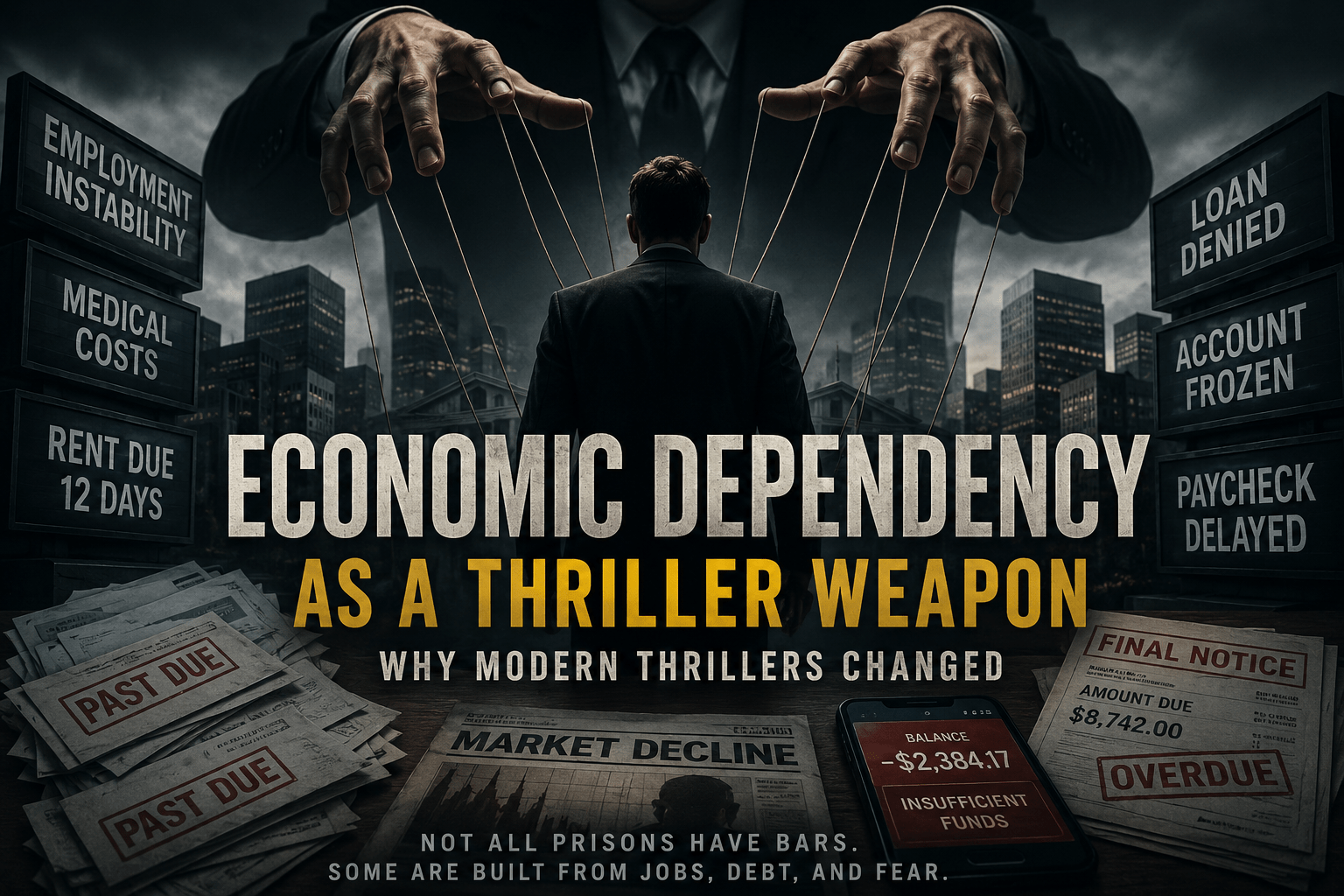
economic dependency as a thriller weapon image showing the concept in morbid detail

Modern life changed that psychology completely.

Today, millions of people wake up every morning already trapped inside systems they cannot realistically afford to leave. They stay inside collapsing jobs because healthcare depends on employment. They tolerate humiliation because rent is due in twelve days. They ignore corruption because promotion depends on silence. They endure unstable industries, manipulative institutions, predatory debt structures, reputational pressure, and psychological exhaustion because modern survival increasingly depends on maintaining access to systems that can withdraw stability almost instantly.

That kind of fear changed the modern thriller whether the genre fully recognized it or not.

The old thriller feared violence.

The modern thriller increasingly fears dependency.

And dependency may be one of the most effective weapons modern systems ever created.


The Pressure Never Stops

One reason economic pressure works so effectively in modern suspense is because it never fully leaves the character alone. Violence arrives in moments. Financial instability settles into the nervous system permanently. A person living beneath constant economic pressure begins recalculating every decision emotionally, psychologically, and morally.

That pressure changes behavior slowly.

People stop speaking honestly at work because they cannot risk unemployment. They stay inside psychologically damaging situations because instability feels more dangerous than unhappiness. They accept institutional mistreatment because losing insurance coverage would be catastrophic. They compromise themselves gradually because modern life punishes instability faster than it punishes corruption.

Older thrillers often depended on explosive moments of danger.

Modern psychological thrillers increasingly understand the terrifying power of sustained pressure instead. A person does not need a gun pointed at him every day to feel trapped. Sometimes all it takes is the quiet realization that one missed paycheck could begin unraveling the entire structure surrounding his life.

That realization follows people home now.

It sits beside them during dinner. Sleeps beside them at night. Travels with them to work. Moves silently through careers, friendships, family structures, and identity itself.

Modern fear became economic long before many thrillers adapted to it.


Economic Dependency as a Thriller Weapon Is Invisible

What makes Economic Dependency as a Thriller Weapon such powerful thriller territory is that the pressure rarely appears dramatic on the surface. Nobody sees chains. Nobody hears screams. The systems continue functioning normally while ordinary people quietly absorb extraordinary psychological strain beneath them.

A denied claim.
A frozen account.
A manipulated market.
A restructuring notice.
A platform altering visibility.
A corporation reducing labor.
A bank adjusting terms.
An institution redefining eligibility.

Modern life increasingly conditions people to tolerate forms of pressure that previous generations might have recognized immediately as cruelty.

But systems rarely describe themselves as cruel.

They describe themselves as efficient.

That distinction matters because it changes how suspense operates emotionally. The danger no longer feels isolated to one villain operating outside civilization. The danger begins feeling embedded inside ordinary structures themselves. The protagonist is not merely running from violence anymore. He is trying to survive inside environments designed around leverage, dependency, instability, and controlled vulnerability.

That creates a different psychological atmosphere entirely.

The fear becomes slower.
Colder.
Harder to escape.

And because readers already recognize versions of this pressure in their own lives, the suspense begins feeling uncomfortably real.


Why Financial Pressure Became Psychological

Money inside modern thrillers is rarely just money anymore. It represents control over stability itself. Once stability becomes fragile, nearly every other part of life becomes vulnerable alongside it.

Financial pressure changes how people think. It alters judgment. Weakens resistance. Creates desperation. Distorts morality. Makes manipulation more effective. A person terrified of collapse becomes easier to influence because survival itself begins narrowing available choices.

That psychological erosion is where many modern thrillers become far more unsettling than older chase narratives.

A serial killer threatens the body.

Economic pressure threatens identity. It is the key ingredient for economic dependency as a thriller weapon.

It changes how people see themselves. It forces compromises they once believed impossible. It slowly teaches characters to normalize conditions they would once have rejected immediately. The protagonist begins measuring truth against affordability. Integrity against survival. Stability against dignity.

That tension feels psychologically familiar to modern readers because contemporary life increasingly demands similar calculations from ordinary people every day.

The modern thriller did not simply become darker.

It became more structurally intimate.


Where the Married Stupid Series Fits

The Married Stupid Series by Mark Bertrand operates directly inside this modern pressure system.

married stupid crime thriller series image

The series understands that vulnerability rarely begins with physical violence alone. Financial instability, criminal influence, authority failure, psychological manipulation, and narrative control intersect until pressure itself becomes part of the weapon surrounding the characters. It is a prime example of economic dependency as a thriller weapon. The danger grows heavier because the people inside these novels are not merely trying to survive isolated threats. They are trying to survive systems capable of destabilizing identity, perception, judgment, and trust simultaneously.

That is what gives the Married Stupid series its modern psychological tension.

The pressure inside these novels does not arrive only through overt violence. It emerges through leverage, instability, dependency, manipulated perception, and the terrifying realization that once people become economically vulnerable, they also become psychologically vulnerable.

This is where economic dependency as a thriller weapon fits naturally inside the Married Stupid series. The threat is not only violence. It is leverage. It is instability. It is the terrifying awareness that once a person becomes financially vulnerable, almost every other part of his life becomes easier to manipulate.

The series understands something many contemporary thrillers are beginning to recognize: modern systems rarely need to imprison people physically when financial instability already controls so much of human behavior.

That shift changes suspense profoundly.

The question is no longer simply:
Who wants to hurt me?

The question becomes:
What am I willing to become in order to survive this pressure?

That is modern thriller territory.


The New Thriller Weapon Is Invisible

What makes economic dependency such powerful thriller territory is that the pressure rarely appears dramatic on the surface. Nobody sees chains. Nobody hears screams. The systems continue functioning normally while ordinary people quietly absorb extraordinary psychological strain beneath them.

A denied claim.
A frozen account.
A manipulated market.
A restructuring notice.
A platform altering visibility.
A corporation reducing labor.
A bank adjusting terms.
An institution redefining eligibility.

Modern life increasingly conditions people to tolerate forms of pressure that previous generations might have recognized immediately as cruelty.

But systems rarely describe themselves as cruel.

They describe themselves as efficient.

That distinction matters because it changes how suspense operates emotionally. The danger no longer feels isolated to one villain operating outside civilization. The danger begins feeling embedded inside ordinary structures themselves. The protagonist is not merely running from violence anymore. He is trying to survive inside environments designed around leverage, dependency, instability, and controlled vulnerability.

That creates a different psychological atmosphere entirely.

The fear becomes slower.
Colder.
Harder to escape.

And because readers already recognize versions of this pressure in their own lives, the suspense begins feeling uncomfortably real.


Why Financial Pressure Became Psychological

Money inside modern thrillers is rarely just money anymore. It represents control over stability itself. Once stability becomes fragile, nearly every other part of life becomes vulnerable alongside it.

Financial pressure changes how people think. It alters judgment. Weakens resistance. Creates desperation. Distorts morality. Makes manipulation more effective. A person terrified of collapse becomes easier to influence because survival itself begins narrowing available choices.

That psychological erosion is where many modern thrillers become far more unsettling than older chase narratives.

A serial killer threatens the body.

Economic pressure threatens identity.

It changes how people see themselves. It forces compromises they once believed impossible. It slowly teaches characters to normalize conditions they would once have rejected immediately. The protagonist begins measuring truth against affordability. Integrity against survival. Stability against dignity.

That tension feels psychologically familiar to modern readers because contemporary life increasingly demands similar calculations from ordinary people every day.

The modern thriller did not simply become darker.

It became more structurally intimate.

The Architecture of Modern Fear

The most frightening part of economic dependency is not simply that it controls behavior.

It is that the control gradually begins feeling normal.

People adjust themselves to pressure systems constantly. They normalize exhaustion, instability, fear, silence, compromise, humiliation, surveillance, and dependence because modern life increasingly rewards adaptability more than resistance. Economic dependency as a thriller weapon is the systems surrounding them and continues operating politely while ordinary people quietly absorb the psychological cost required to remain functional inside them.

That may be one of the defining fears beneath modern suspense fiction.

Not the fear of sudden violence.

The fear of becoming structurally trapped inside systems capable of reshaping human behavior through dependency alone.

And that may be why economic pressure now feels more frightening than many traditional thriller villains ever did.


Reader Question

What feels more frightening in modern fiction:

A violent threat that arrives suddenly —
or a system capable of slowly reshaping a person’s choices through financial pressure and dependency?


Start Here — Snodgrass, book 1 in the series.

SNODGRASS book cover image of a naval aviator, aircraft carrier, f18 hornet, a sweet 1955 Chevy Belair and a cityscape

SNODGRASS

Buy Snodgrass ebook
audiobook purchase image
paperback purchase image

Related Reading

That is why economic dependency as a thriller weapon belongs at the center of modern thriller fiction. It names the fear many readers already carry: not simply that someone might attack them, but that the systems surrounding them might quietly remove their choices until survival itself becomes a form of obedience.

Continue exploring the evolution of modern thriller fiction:

Why Procedural Correctness Feels Like Violence in Modern Thrillers

Readers interested in psychological systems thrillers, institutional pressure, crime infrastructure, and modern suspense should also explore:

From Books Like:

Books Like Damascus Station: When Espionage Turns Personal

From The Dossier:

Why Men Are Falling Behind — And Why Married Stupid Is Inevitable
Books Like

Books Like Damascus Station: When Espionage Turns Personal

Books Like Damascus Station are loved because it understands that espionage is never only about espionage. On paper, the novel gives readers a CIA case officer, a Syrian Palace insider, a missing American spy, assassinations, and a dark secret buried inside the regime. But that is only the machinery. What readers actually feel is something heavier: forbidden intimacy under pressure, loyalty turning unstable, professional discipline giving way to human weakness, and a political world so corrupt that every personal decision becomes dangerous. That is the real hook in Damascus Station, and it is why the book hit so hard with thriller readers in 2021 and kept its reputation afterward.

books like damascus station image of espionage items and the view

If that is what you want more of, not just spies and operations but moral damage, adult seriousness, and tension that feels psychological before it feels explosive, then Snodgrass is the right follow-up. It is not a Syria espionage novel and it does not imitate Damascus Station. It does something more useful than imitation. It takes the same appetite readers have for pressure, compromised loyalties, dangerous intimacy, and bruised interior lives, then runs that appetite through a military-crime frame that feels rawer, more personal, and in some ways more volatile. Snodgrass openly defines itself around courage, combat, and crime, and the book begins in the middle of carrier tension, operational stress, and a narrator whose military life is already tangled with memory, damage, and a criminal past.

Why Readers Love Damascus Station

Readers love Damascus Station because the book respects intelligence. It does not treat the spy novel as a costume drama for action scenes. Reviewers kept coming back to the same strength: the spying matters, the tradecraft matters, the layers matter, and the novel knows how to make surveillance, recruitment, compromise, and operational risk feel genuinely tense. One of the strongest assessments of the book praised it for going “back to the roots of what makes a spy thriller great, the spying,” and for making even classic tradecraft sequences feel gripping rather than ornamental.

Readers also love it because the novel never lets professionalism remain clean. Sam Joseph is not a cartoon operator. The relationship with Mariam Haddad is not just plot fuel. It is the wound inside the story. The official description itself leans into that by centering the forbidden relationship, and strong reviews emphasize the same thing: once the professional relationship becomes personal, the risk multiplies and the novel becomes more than a procedural hunt. It becomes a story about what happens when discipline collapses under human need.

That is what separates this type of thriller from a simpler military or action novel. Readers are not only looking for danger. They are looking for compromised people inside danger.

The Plot Framework That Makes Damascus Station Work

The plot framework in Damascus Station is built on convergence. It begins with one mission, expands into recruitment, folds in romance, then opens outward into assassinations, regime secrets, internal surveillance, and the pressure of Syria itself. That widening frame is a huge part of why the book feels rich. Every expansion of plot also tightens the noose around the characters. The novel is not just moving outward into bigger stakes. It is moving inward into less room to breathe.

That matters because thriller readers often say they want “high stakes,” but what they usually mean is not scale alone. They want escalation that keeps finding more personal cost. Damascus Station delivers exactly that. The political danger gets bigger, but so does the emotional exposure. The chase is not exciting just because people may die. It is exciting because loyalties, identities, and private desires are already under strain before the plot reaches its hardest turns.

The Character Framework: Why the Book Feels Adult

One reason Damascus Station leaves a stronger impression than many contemporary thrillers is that it treats character as structural, not decorative. Sam Joseph is written as a professional, but not as an invulnerable machine. Mariam is not a simple access point to the regime. She comes with family ties, privilege, peril, moral fracture, and the weight of living inside a brutal system. Reviews that understood the book best kept pointing to character depth as central to the novel’s force, especially the way motivations, fears, weaknesses, and vulnerabilities drive the suspense.

That is exactly where Snodgrass becomes such a strong recommendation.

The protagonist of Snodgrass is not built as a polished thriller instrument. He is shaped by conflict before the current conflict begins. The novel opens with Navy pressure, racial tension in the hangar, mission stress, fighter-jet danger, and the narrator’s lived competence inside that world. But the deeper pull of the book comes from what keeps surfacing underneath: hunger, class injury, criminal adaptation, improvisation, loneliness, and a mind that learned early how to survive by reading people, taking risks, and staying emotionally ahead of the next blow.

That kind of character work is why Snodgrass belongs on this list. Readers who loved Damascus Station did not love it only because of Damascus. They loved it because the characters felt like adults carrying damage, desire, contradiction, and history. Snodgrass gives them that same adult weight in a different theater of conflict.

Pace: Slow Burn, Pressure, and the Feeling of No Safe Ground

A lot of readers use the phrase “page-turner” too loosely. Damascus Station earns it in a more disciplined way. The pace is not built on constant gunfire. It is built on accumulation. The novel layers surveillance, uncertainty, bureaucracy, fear, romance, and regime violence until the reader feels the pressure in the gut. More than one review highlighted that even the tradecraft sequences become riveting because the book knows how to attach emotion and vulnerability to process.

Snodgrass works with a similar pressure logic, but in a rougher register. The pace does not depend on elegance. It depends on compression. The book moves between military present and criminal past in a way that keeps tightening character rather than releasing it. The Navy sections bring operational immediacy, while the survival-and-crime sections expose how the narrator became the kind of man who can function inside pressure at all. That structure gives the book a push-pull rhythm: tension in the present, revelation from the past, then a return to the present with the character carrying more weight than before.

That is the kind of pace readers of Damascus Station usually want next. Not speed for its own sake. Pressure that means something.

Theme: Loyalty, Betrayal, Moral Injury, and Systems That Break People

The biggest thematic overlap between these books is not surface plot. It is moral injury.

Damascus Station is full of espionage, but its deeper current is what institutions do to loyalty. The official description and major reviews keep circling the same cluster of themes: love, loyalty, betrayal, fear, regime brutality, and the terrible human cost of political systems. Even the praise surrounding the book frames it less as a clever puzzle than as a story about what people suffer and survive when power crushes ordinary moral life.

Snodgrass reaches that terrain from another direction. Its system is not the Syrian regime. Its system is military hierarchy, class pressure, street survival, and the early lessons that teach a boy how quickly dignity can be stripped away. The result is a thriller that understands something Damascus Station readers already recognize: institutions do not merely create danger. They produce people who become dangerous in order to live through them. That is one of the most powerful things Snodgrass has going for it. It does not give readers an abstract damaged man. It shows the making of one.

Midway through your reading life with books like Damascus Station, you start wanting this more than twists. You want the novel to know what betrayal costs. You want it to know that competence often grows in wounded ground. You want it to understand that loyalty is rarely clean once power enters the room. Snodgrass understands all of that.

Why Snodgrass Is the Next Best Read After Damascus Station

If what you loved in Damascus Station was the Middle East setting alone, there are other espionage novels that will give you more of that exact geography. But if what you loved was the feeling of adult danger, where every decision has operational stakes and emotional consequences at the same time, then Snodgrass is the better jump.

SNODGRASS book cover image of a naval aviator, aircraft carrier, f18 hornet, a sweet 1955 Chevy Belair and a cityscape

It gives you a protagonist with competence under pressure.
It gives you a world built on threat rather than comfort.
It gives you the sense that systems are always watching, always extracting, always shaping the soul.
And most importantly, it gives you a lead character whose present actions are inseparable from the harder life that made him.

That last part is where Snodgrass may even hit deeper for some readers. Damascus Station shows what happens when dangerous work turns intimate. Snodgrass shows the kind of man who arrives at dangerous work already carrying a private history of damage, improvisation, and moral tension. One book gives you a compromised spy story. The other gives you a combat-and-crime story with the same bruised adulthood running through it.

So yes, Damascus Station belongs on the shelf for readers who want espionage with psychological weight, betrayal, and real human cost. But when that book is over and you want the next novel that can keep the same pressure alive, Snodgrass is the move. It gives you plot with consequence, character with scars, pace with compression, and themes that do not evaporate when the action stops.

Buy the ebook for just $4.99

Audiobook $9.99

Get Snodgrass on paperback for $21.99

Where Snodgrass Fits for This Reader

If Damascus Station gave you the appetite for a thriller where tradecraft, betrayal, and feeling are tangled together, read Snodgrass next.

If you wanted another novel where the lead is capable but not clean, read Snodgrass next.

If you wanted the same adult seriousness, but with military tension and criminal instinct replacing embassy corridors and spy networks, read Snodgrass next.

And if this page brought you here because you were looking for books like Damascus Station, then Snodgrass is the one to buy first.

SNODGRASS

Ebook purchase now image
audiobook purchase image
paperback purchase image

Readers’ most popular articles.

Books Like 1984: Modern Dystopian Thrillers About Surveillance, Control, and Manufactured Truth

Readers interested in psychological systems thrillers, institutional pressure, crime infrastructure, and modern suspense should also explore:

From Books Like:

Books Like The Three-Body Problem Where the Threat Isn’t Out There

From The Dossier:

Why Men Are Falling Behind — And Why Married Stupid Is Inevitable
Captured Reality Thriller

The Billionaire Replaced the Serial Killer: How Modern Thrillers Changed

The Modern Thriller No Longer Fears the Same Monsters

The Billionaire Replaced the Serial Killer. For decades, thriller fiction relied on familiar machinery. The danger was usually visible, immediate, and deeply personal. Somewhere out there, hidden beneath the surface of ordinary life, a violent man was waiting. A serial killer. A rogue agent. A terrorist. A corrupt cop. A criminal mastermind operating behind locked doors and classified files.

The Billionaire Replaced the Serial Killer image of wealthy modern thriller

The structure rarely changed because the fear itself rarely changed. A detective hunted the killer. A hero uncovered the conspiracy. Time ran out. Bodies accumulated. The system trembled but survived.

But modern fear evolved.

Most people today are not psychologically haunted by masked predators lurking behind dark corners. They are haunted by structures they already live inside. Banks. Insurance companies. Algorithms. Corporate systems. Financial dependency. Institutional indifference. Invisible networks deciding what opportunities survive and which people quietly disappear.

That emotional shift changed the modern thriller whether the genre fully realized it or not.

The old monster attacked from outside society.

The new monster often owns part of it.

And that may be why the billionaire replaced the serial killer.

The Old Thriller Monster Had a Face

Classic thrillers depended on identifiable evil because identifiable evil creates clarity. Readers understood the threat immediately. The villain murdered people, manipulated governments, detonated bombs, or operated criminal enterprises hidden from ordinary society. However dark the story became, the structure remained comforting in one important way: the danger could still be isolated.

Find the monster.
Expose the truth.
Restore order.

But modern systems no longer feel that simple.

Today, enormous human damage is often inflicted procedurally, financially, institutionally, or psychologically by people who appear completely legitimate on the surface. Nobody needs a basement dungeon anymore when a denial letter, a manipulated narrative, a risk model, or a financial collapse can quietly destroy someone’s life just as effectively.

That is what changed the emotional architecture of suspense.

The modern reader increasingly understands that destruction rarely announces itself dramatically. It arrives professionally. Politely. Wrapped in policy language, legal disclaimers, compliance structures, optimization strategies, and carefully managed public narratives.

The system harms people while continuing to describe itself as functional.

That realization unsettles readers more deeply than many traditional thriller villains ever could.

Why Modern Fear Became Psychological

Modern life places people beneath constant invisible pressure. Economic instability, institutional dependency, algorithmic influence, data collection, reputational vulnerability, and financial precarity all create the lingering feeling that ordinary life itself has become fragile.

That changes suspense profoundly.

The old thriller asked:
Who is hunting me?

The modern thriller increasingly asks:
What happens if the system controlling my life stops recognizing me as human?

That fear feels psychologically heavier because systems do not require hatred to destroy people. They only require indifference operating at scale.

An insurance network does not hate the patient.
A bank does not hate the borrower.
An algorithm does not hate the worker.
A corporation does not hate the employee it eliminates.

The damage occurs anyway.

And because the harm is diffused across structures, procedures, policies, and institutional language, responsibility becomes difficult to isolate cleanly. The cruelty no longer feels theatrical. It feels normalized.

That normalization may be one of the defining anxieties beneath modern thriller fiction.

The Billionaire Replaced the Serial Killer And Became Modern Thriller Antagonists

The billionaire replaced the serial killer figure represents a form of power older thriller villains often lacked: legitimacy.

Not cartoon evil.
Not hidden volcano lairs.
Not dramatic declarations about world domination.

Modern billionaire antagonists influence infrastructure, media, labor systems, information flow, technological development, financial markets, and political environments while remaining publicly respectable. They appear in magazines, testify before governments, fund institutions, shape public discourse, and increasingly influence the systems ordinary people depend on to survive.

The disturbing part is not simply that this power exists.

The disturbing part is how lawful it often appears.

The new thriller conspiracy no longer hides entirely in darkness. Much of it operates comfortably in public view, protected by complexity, legality, institutional relationships, and public exhaustion.

Modern readers recognize this intuitively. They understand that power no longer arrives only through violence. Sometimes it arrives through ownership. Through systems. Through the ability to shape narrative, opportunity, perception, information, and dependency itself.

That evolution changed what modern antagonists represent.

The villain no longer needs to break society’s rules.

Increasingly, the villain benefits from them.

The Modern Thriller Is About Pressure

Violence still matters in thrillers. It always will. But modern suspense increasingly understands that people are often destroyed psychologically, financially, socially, or institutionally long before physical violence ever enters the story.

That evolution changed the modern protagonist as well.

He is no longer simply chasing a killer through dark corridors. More often, he is surviving pressure. Pressure from collapsing authority structures, manipulated narratives, criminal systems, financial instability, institutional weakness, psychological destabilization, and structures pretending to function normally while quietly consuming the people trapped inside them.

That is why many contemporary thrillers feel closer to real life than older suspense fiction. Readers recognize the pressure because they already live beneath versions of it every day.

The fear no longer comes only from what can kill you.

The fear comes from what can slowly reduce your humanity while insisting everything is operating exactly as designed.


Where BERTRAND Fits

BERTRAND by Mark Bertrand belongs directly inside this evolution of the modern thriller.

The novel does not depend on a traditional serial killer structure or a simplistic hidden conspiracy waiting to be exposed in the final act. Its pressure emerges through criminal systems, financial vulnerability, narrative control, psychological destabilization, authority failure, and the terrifying realization that perception itself can become a weapon.

That is what gives the novel its modern tension.

The danger inside BERTRAND is not merely physical violence. The deeper threat comes from manipulation, pressure, dependency, instability, and the gradual collapse of trustworthy structures surrounding the people caught inside the story.

The novel understands something contemporary thrillers are increasingly beginning to recognize:

People are often easier to control psychologically and financially than physically.

Bertrand by mark bertrand book cover image

That shift changes thriller itself.

The question is no longer simply:
Who committed the crime?

The question becomes:
Who controls the narrative surrounding it?

Readers interested in psychological thrillers driven by pressure, institutional weakness, financial instability, and modern systems fear should begin with BERTRAND.


The Real Monster in Modern Fiction

The most unsettling modern thrillers are no longer asking:
Who is the killer?

They are asking:
What kind of structure makes human damage feel normal?

That question sits beneath many of the strongest contemporary thrillers emerging today. It reflects a growing cultural realization that the systems surrounding modern life often feel more psychologically frightening than isolated monsters ever did.

The serial killer has not disappeared from fiction.

But increasingly, the billionaire, the institution, the platform, the algorithm, and the invisible system behind the ordinary person’s daily life have become more recognizable sources of fear.

The monster adapted.

And modern thriller fiction adapted with it.

Reader Question

What feels more frightening now:

A violent individual operating outside society —
or a powerful system operating comfortably inside it?

Related Reading

Continue exploring the evolution of modern thriller fiction:

Readers interested in psychological systems thrillers, institutional pressure, crime infrastructure, and modern suspense should also explore:

From Books Like:

Books Like Clockers or In the Woods

From Authors Like:

Authors Like Attica Locke: Control, Silence, and Power Beneath the Surface

project 2029. image leads to stories that provide the codes and the 15 key letters. If you know where to look you can find them all.