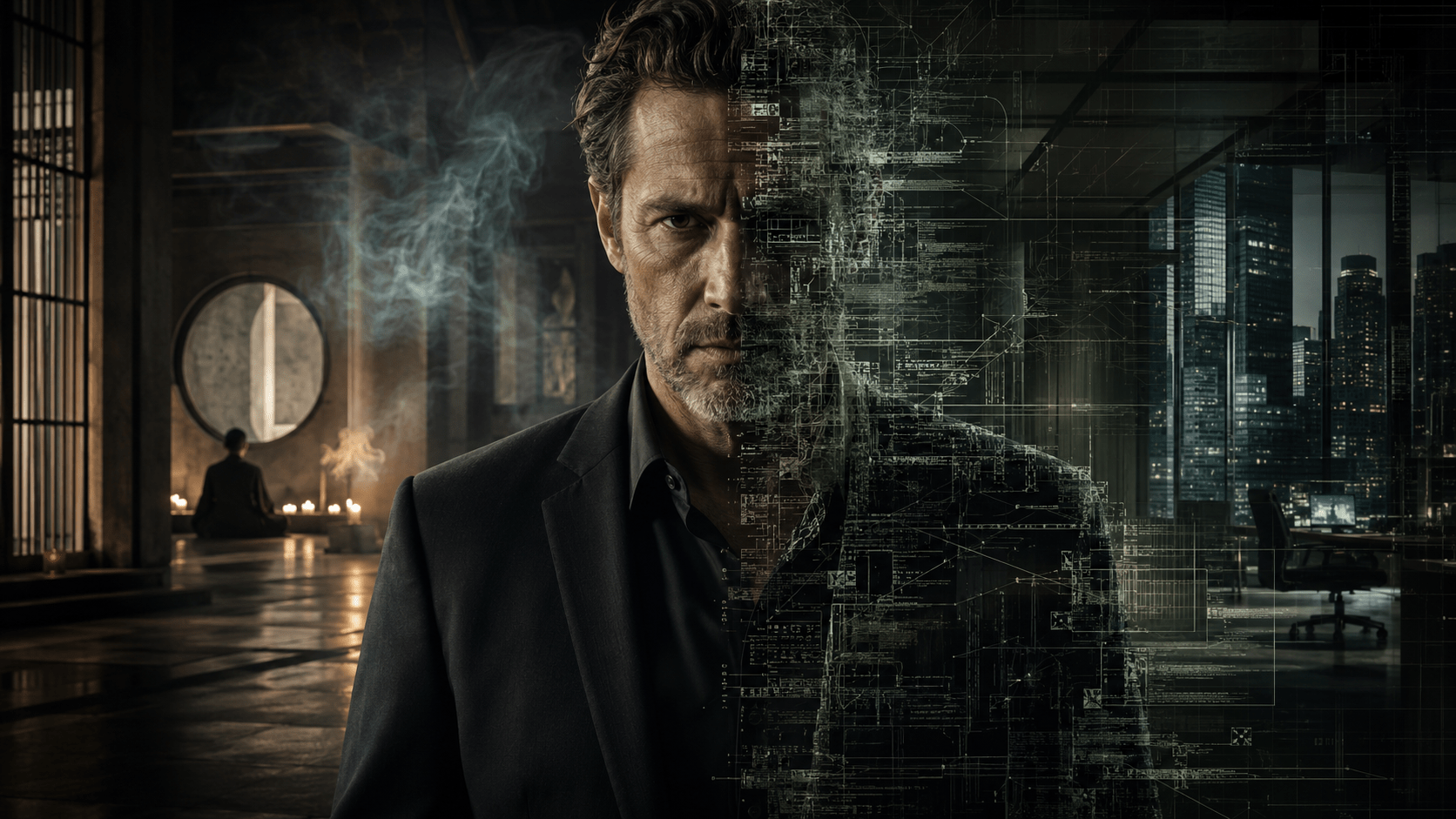
The Married Stupid Series tag collects articles that explore the deeper narrative structure connecting the novels in the series. These essays examine recurring character pressures, hidden motivations, and the evolving systems of power shaping events across multiple books. By looking beneath the surface plotlines, these pieces reveal how decisions, relationships, and moral tensions echo across the series and reshape earlier moments when viewed with the full story in mind.
The easiest mistake a reader can make with the novel BERTRAND is to think the story is about a man trying to get rich. It is not. It’s about The Man Who Became 7 Systems. Money is only the visible hunger. Wealth is the object he can name, count, move, hide, and chase. But beneath the money is something more dangerous: the need to escape being merely human inside systems that treat ordinary human life as disposable.
The novel does not begin with a criminal. It begins with a man who has learned too much. He has learned how corporations harvest brilliance and return pocket change. He has learned how governments protect wealth while punishing survival. He has learned how spiritual language can calm suffering without changing the machinery that creates it. He has learned how banks, contracts, schools, churches, families, and employers all claim moral authority while quietly training the poor to accept less.
So he adapts.
That is the first turn.
He does not merely break rules. He studies them. He watches them until they reveal their weakness. Then he builds around them. What begins as self-defense becomes structure. What begins as rage becomes method. What begins as a man trying to survive becomes something colder, cleaner, and harder to stop.
Mark Bertrand does not simply use systems.
He becomes one.
The first system is injury
Every system in the novel begins with a wound.
The corporate system wounds him by using his talent and refusing to pay him in proportion to the value he creates. The family system wounds him by failing to give him a usable model for adult life. The religious system wounds him by offering obedience where he needs tools. The financial system wounds him by pretending the game is open while reserving the real doors for those already inside.
That is why the book’s anger is not decorative. It is structural. The rage is not there to make the narrator sound dangerous. It is there because the narrator has correctly identified the insult: the world asks him to believe in merit while proving, again and again, that merit is only useful when someone richer can profit from it.
This is the wound that hardens him.
A normal novel might make that wound sentimental. BERTRAND does not. It lets the wound become intelligence. That is part of what makes the book uncomfortable. The narrator is not wrong about the system. Much of what he sees is accurate. Corporations do take. Executives do capture value. Institutions do polish theft until it looks like procedure. The poor are told to work harder while the wealthy are allowed to rewrite the rules.
The danger is not that Mark sees the rot.
The danger is that he decides rot is permission.
Once that happens, morality becomes negotiable. Fairness becomes childish. Legality becomes a costume worn by power. If the system is corrupt, then corruption begins to look less like a fall and more like fluency.
That is the first real horror of the novel.
The system teaches him how to become its child.
The second system is performance
Mark survives by learning how to appear.
He appears as the talented engineer. The corporate problem solver. The disciplined operator. The serious student. The spiritual seeker. The meditation teacher. The businessman. The man with answers. The man who understands both money and suffering.
Each role is real enough to be convincing. That matters. He is not a simple fraud hiding behind false masks. He is talented. He is disciplined. He is often the smartest person in the room. He does solve problems. He does understand people. He does know how machinery works, whether the machinery is mechanical, financial, bureaucratic, or spiritual.
That is what makes the performance so lethal.
A bad liar needs invention. Mark needs arrangement.
He takes true parts of himself and places them where they are most useful. The engineer becomes proof of competence. The spiritual seeker becomes proof of depth. The businessman becomes proof of legitimacy. The victim of class injury becomes proof of motive. The man wronged by corporations becomes proof that whatever he does next is not theft but correction.
He performs legitimacy so well that legitimacy begins to obey him.
That is why the “system” theme matters. Mark is not only hiding from institutions. He is replicating them. He learns their logic and builds a smaller version of it around himself. His life becomes departments. Finance. Identity. Desire. Secrecy. Intimacy. Risk. Spiritual cover. Each department has its own language. Each language has its own justification.
This is not chaos.
This is administration.
Purchase BERTRAND
Members Only Content: The third system is identity
Identity in BERTRAND is never stable.
The name “Mark” is useful, but insufficient. The man needs more than
This content is for members only.
Not yet a member? Request member access to The Dossier.
The envelope arrived on a Thursday afternoon in late October. Daniel Mercer almost threw it away with the grocery flyers. The return address carried the blue logo of American Unified Assurance, the same company he had worked for since 1994. Thirty-two years. Long enough to watch the office change from carbon forms and fax machines to cloud terminals and predictive systems that made decisions before human beings even opened files.
He stood in the kitchen holding the envelope while rain tapped softly against the window over the sink. The house smelled like tomato sauce and garlic bread. His wife, Elaine, stirred a pot at the stove while some cable news panel argued in the living room about productivity growth and the “new efficiency economy.”
Daniel hated that phrase.
Efficiency economy.
It sounded clean.
Like nobody disappeared inside it.
“Anything important?” Elaine asked.
He shrugged.
“Probably enrollment garbage.”
He opened the envelope carefully anyway. Daniel Mercer had spent his life opening envelopes carefully. Insurance trained that into people. Tiny words buried in documents could alter entire futures.
He slid the paper out.
The first thing he saw was the phrase:
WORKFORCE TRANSITION NOTICE
Then:
POSITION ELIMINATION
Then:
AUTOMATED CLAIMS INTEGRATION PHASE IV
He read the letter twice before his mind accepted it.
The company thanked him for his years of service.
The company acknowledged his dedication.
The company informed him his position would conclude in fourteen business days.
Fourteen days.
Thirty-two years converted into fourteen business days.
The kitchen suddenly sounded very far away.
The rain. The television. The boiling sauce. Elaine humming quietly at the stove.
All of it distant.
His eyes settled on the severance figure near the bottom of the page.
Eight weeks.
He actually laughed.
Not because it was funny.
Because something inside him briefly lost contact with reality.
“Daniel?”
Elaine had turned around.
He handed her the letter without speaking.
She read slower than he had. Her eyes narrowed carefully down the page, like maybe the wording would improve before the end.
It didn’t.
“They’re replacing you with software?”
“Not software,” Daniel said quietly. “Integrated automation.”
He hated how naturally the phrase came out of his mouth.
The company had spent years teaching employees the language that would eventually erase them.
The television panel continued talking.
Historic productivity growth. Record market performance. AI-driven acceleration. Investor confidence.
The stock ticker rolled endlessly beneath smiling faces.
Daniel stared at it.
American Unified Assurance stock had climbed thirty-eight percent in sixteen months.
That same quarter, the company had announced “human capital streamlining initiatives.”
Human capital.
Another clean phrase.
Like people were wiring or plumbing.
Elaine folded the letter carefully and placed it on the kitchen table beside the unopened electric bill.
“What do we do?”
That question entered the room softly.
But it stayed there.
Their daughter Rachel lived upstairs while finishing graduate school online because apartments in the city had become impossible. Their son Caleb delivered groceries, drove rideshare at night, and slept four hours a day despite holding a degree in economics.
Daniel had believed education protected people.
He wasn’t sure anybody believed that anymore.
The kitchen table had become a museum of modern survival:
Prescription receipts. Tuition notices. Mortgage refinances. Insurance adjustments. Streaming subscriptions they forgot to cancel because exhaustion made small decisions feel impossible.
And now this.
Daniel looked through the window above the sink toward the dark neighborhood.
Almost every house on the block belonged to somebody who worked for systems now replacing them.
That afternoon the company gathered remaining staff into Conference Room B.
A young regional vice president named Claire Whitmore stood at the front beside a massive presentation screen.
Daniel immediately disliked how rested she looked.
Claire spoke calmly.
The transition was necessary. The industry was evolving. Shareholder expectations required modernization. Competitiveness demanded innovation.
Daniel watched people sitting around the conference table.
Forty years old. Fifty-five. Sixty-two.
Human beings listening to PowerPoint explanations for their own obsolescence.
Then Claire said the sentence Daniel would remember for the rest of his life.
“Productivity growth is essential to national economic stability.”
National economic stability.
The room fell completely silent.
Daniel realized something horrifying:
The suffering was no longer considered unfortunate side damage.
It was being reframed as patriotic necessity.
That evening Caleb came home exhausted from driving.
Daniel handed him the termination letter.
Caleb read it slowly.
“They automated claims already?”
“Apparently.”
Caleb sat heavily into a kitchen chair.
“You know what’s insane?” he said quietly. “The economy’s technically booming.”
Daniel looked at him.
Caleb continued:
“Markets are breaking records. Productivity’s exploding. GDP’s climbing. But nobody I know can afford a house. Or kids. Or time off. Or medical emergencies.”
He laughed softly.
“It’s like the country became successful without the people inside it.”
That sentence hung over the kitchen table long after dinner ended.
Two weeks later Daniel carried a cardboard box out of the building containing framed family photographs, a ceramic coffee mug, and thirty-two years of accumulated office debris nobody would ever look at again.
Rain fell lightly across the parking lot.
Employees exiting beside him carried identical boxes.
An entire generation of labor quietly removed from the system.
No protest. No violence. No revolution.
Just cardboard boxes beneath corporate rain.
Three months later Congress introduced something called The Productivity Act.
The proposal dominated every news channel in America.
The bill would create a permanent national trust funded by taxes on large-scale automation gains, federally subsidized AI infrastructure, algorithmic financial transactions, and sovereign commercial data licensing.
Every American citizen would receive an annual national dividend payment.
Not welfare.
Not unemployment.
Ownership participation in national productivity growth.
The President called it:
“The natural evolution of Social Security in the age of artificial productivity.”
That phrase detonated across the country.
The markets immediately plunged.
Corporate coalitions declared the bill unconstitutional.
Financial networks called it economic extremism.
Technology executives warned innovation itself could collapse.
But for the first time in years, Daniel watched ordinary people talking about the future without sounding defeated.
Then the lawsuits arrived.
Massive corporate alliances sued the federal government before the bill could even fully activate.
Their argument was brutally simple:
Private productivity gains belong to private owners.
The government cannot redefine prosperity as collective ownership merely because society helped create the conditions for growth.
The hearings began in Washington during the coldest January in decades.
Daniel watched them every day from his living room recliner beside stacks of unpaid medical bills and a yellow legal pad covered in job applications nobody answered anymore.
The corporate attorneys spoke calmly about constitutional protections, investor rights, fiduciary obligations, and economic freedom.
Then one attorney said something that made Elaine stop folding laundry and stare at the television.
“Corporations do not exist to provide happiness, meaning, or social stability. Their purpose is lawful return on investment.”
The room inside the hearing chamber remained perfectly calm after the sentence.
Nobody shouted.
Nobody gasped.
But Daniel felt something inside him shift permanently.
Because there it was.
The truth.
Not hidden anymore.
Not implied.
Said openly into microphones beneath the seal of the United States government.
The nation that once promised pursuit of happiness had legally reorganized itself around the emotional needs of capital.
That night Daniel sat alone at the kitchen table.
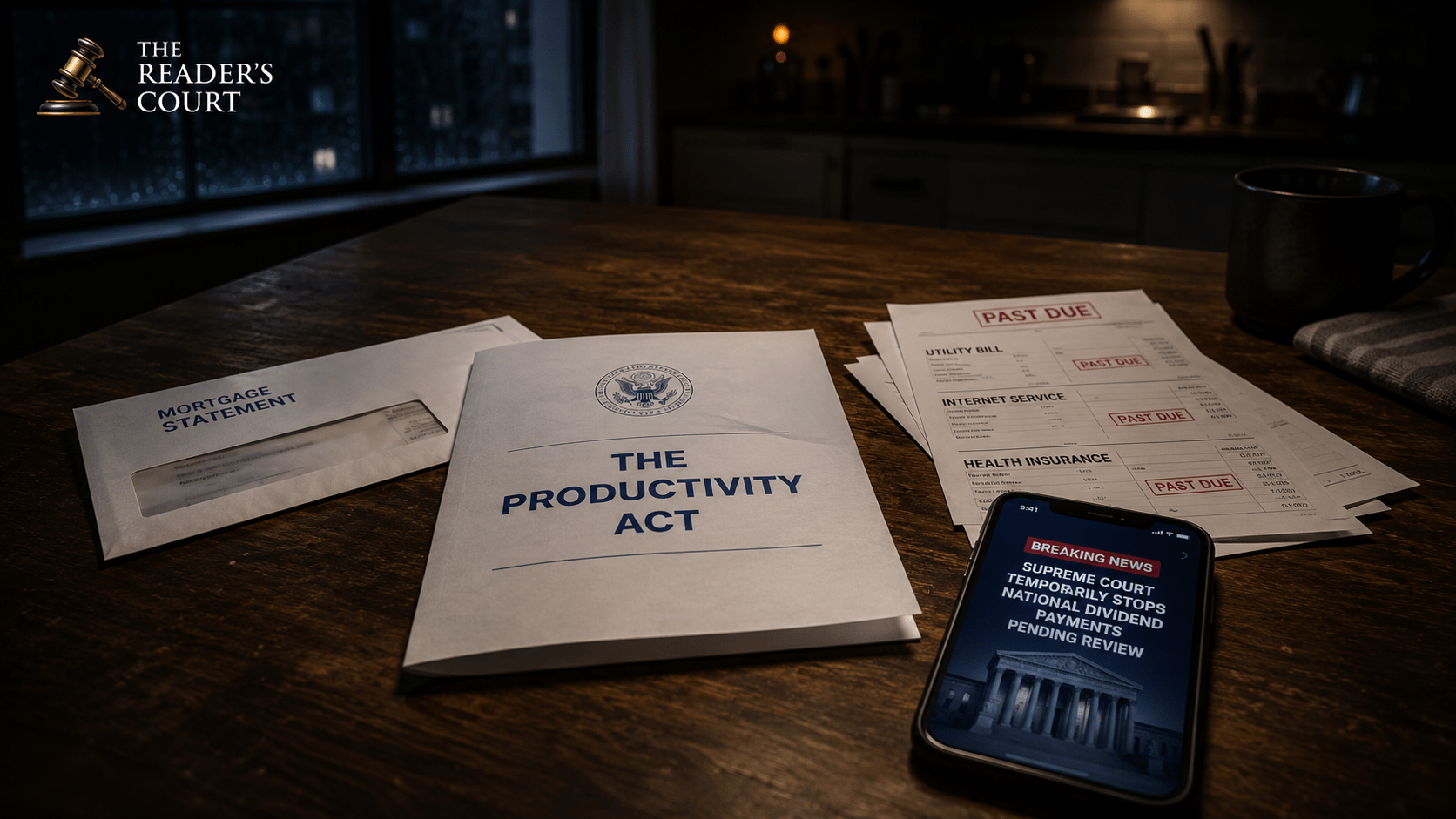
The dividend proposal pamphlet lay beside him.
Simple white paper.
Blue lettering.
THE PRODUCTIVITY ACT
A future small enough to fit inside an envelope.
His eyes moved toward the television where financial analysts discussed market reactions.
Behind them rolled another green ticker climbing endlessly upward.
Productivity rising.
Profits rising.
Human beings disappearing beneath the graph.
Then the Supreme Court agreed to hear the case.
And suddenly the entire country understood what was actually on trial.
Not a tax.
Not a bill.
A civilization trying to decide whether its people still deserved to share in the prosperity they created.
The hearing would begin Monday morning.
Daniel folded the pamphlet carefully and placed it beside the unopened mortgage statement at the center of the kitchen table.
Then his phone vibrated.
A breaking news alert appeared across the screen.
SUPREME COURT ISSUES TEMPORARY STAY ON NATIONAL DIVIDEND PAYMENTS PENDING CONSTITUTIONAL REVIEW
The room went completely silent.
The pamphlet remained on the table between the bills.
A promise waiting for permission to exist.
Become a member of the Dossier. Support my writing.
The Question | The Productivity Act
The nation became wealthier.
Productivity exploded. Automation accelerated. Markets climbed higher than ever before.
But millions of citizens found themselves increasingly disconnected from the prosperity surrounding them.
The Productivity Act proposed a simple idea:
If an entire civilization contributes to national wealth, should the people themselves share ownership in that growth?
The corporations argued no.
They claimed productivity gains belong to private enterprise, private investment, and private risk.
The government argued something different.
That public infrastructure, public research, public stability, public labor, and public systems helped create the wealth in the first place.
So who does prosperity belong to?
The investors who legally own the systems?
Or the nation whose people made the systems possible?
The Autopsy | The Productivity Act
The Productivity Act exposes something modern economies work very hard to conceal:
Advanced capitalism increasingly separates productivity from human participation.
For most of industrial history, rising productivity still required large populations of workers. Even exploitative systems needed human labor in visible ways. Workers remained economically necessary.
Automation changed that relationship.
Artificial intelligence accelerated it further.
Modern corporations can now increase output, efficiency, market valuation, and investor return while steadily reducing their dependence on human labor itself.
That creates a structural problem the legal system is not designed to solve.
The economy continues producing wealth. But fewer citizens meaningfully participate in ownership of that wealth.
Social Security partially addressed this problem in an earlier era.
It acknowledged a dangerous truth: A modern nation cannot allow citizens to become disposable simply because markets evolve.
But Social Security remained tied to wages and payroll participation. It never evolved into broad public ownership of national productivity itself.
The Productivity Act attempts that next step.
Not socialism. Not abolition of markets.
A public dividend system recognizing that modern prosperity emerges from layered collective contributions:
public infrastructure public research universities government-funded technology development military protection of trade systems federal reserve stabilization communications networks legal enforcement systems taxpayer-funded scientific advancement
Private enterprise benefits enormously from these systems while ownership gains increasingly concentrate upward into investment structures insulated from ordinary citizens.
The legal resistance to the Productivity Act reveals the deeper architecture beneath corporate law.
Corporate entities are not legally designed to maximize human happiness, social cohesion, or democratic stability.
They are designed to maximize lawful return.
That distinction matters enormously.
Because once productivity becomes detached from labor participation, the system quietly faces a question it was never morally designed to answer:
What happens to human beings when the economy no longer requires most of them to remain economically useful?
The courts struggle with this because constitutional and corporate law evolved primarily to protect property structures, contractual stability, investment predictability, and capital continuity.
Not emotional well-being. Not dignity. Not social meaning.
The system protects ownership because ownership stabilizes wealth concentration and institutional continuity.
That is why the Productivity Act terrifies powerful institutions.
Not because the dividend itself would bankrupt the economy.
But because it reframes prosperity as something civilization collectively creates rather than something capital owners alone deserve to inherit.
The deeper fear is philosophical.
If citizens possess rightful claims to national productivity, then modern capitalism may owe obligations beyond shareholder return.
And once that door opens, the entire moral architecture of corporate power begins to change.
The Reader’s Verdict | The Productivity Act
The country increased its productivity.
The question became whether human beings still had a claim to the prosperity surrounding them.
The corporations defended ownership.
The government defended participation.
The courts defended the structure already in place.
No one needed to hate the people losing their place in the economy.
The system only required that profitability remain legally superior to human belonging.
Social Security once acknowledged that markets alone could not hold a nation together.
The Productivity Act asked whether that principle should continue evolving.
The court did not ask what created the healthiest society.
It asked what the existing structure permitted.
And structures designed around capital continuity rarely recognize happiness as an enforceable right.
The system did not fail.
It answered the question it was designed to answer.
Now it’s up to you.
A. Protect private ownership. Productivity gains belong to the companies and investors who legally own the systems that produced them.
B. Create the national dividend. If public labor, public research, public infrastructure, and public stability helped create the wealth, citizens deserve a direct share of it.
C. Split the claim. Private companies may keep most productivity gains, but extraordinary automation profits should fund a permanent public dividend for the people displaced by them.
What is the right thing to do? Leave your verdict — A, B, or C — in the comments.
Exhibit A: Case #001 | The money that looked guilty.
Trooper Nathan Calder had decided to stop the sedan before it passed him.
It was not speeding. The gray Nissan moved along Interstate 40 at exactly seventy-five, the late afternoon sun pressing the desert flat into bands of copper, dust, and heat shimmer. The driver held the right lane with such disciplined steadiness that it felt less like driving than obedience.
That was what caught Calder’s eye.
Most people changed when they saw a patrol car. They touched the brake too quickly. Drifted. Checked their mirrors too often. Tried to look casual and failed.
This man did none of that.
He held the wheel at ten and two as if someone had taught him how innocence should look.
Calder pulled onto the interstate and let the sedan pass. Illinois plates. Rental sticker on the windshield. Clean car. Anonymous. The kind that belonged nowhere and moved through everything.
He settled in behind it.
Three miles. No lane drift. No creeping over the limit. No sudden correction. Just a man in a rental, driving as if attention itself were dangerous.
Calder hit the lights.
The sedan moved onto the shoulder at once, gravel ticking under the tires. Before Calder reached the window, it was already lowering.
“Good afternoon, officer.”
The driver looked mid-forties. Thin face. Tired eyes. A paperback sat on the passenger seat with a boarding pass tucked inside. Two suit jackets hung from the rear handle under dry-cleaning plastic.
“Do you know why I stopped you?” Calder asked.
“No, sir.”
“Your lane discipline was unusual.”
The man blinked once, thoughtful rather than rattled.
“I was trying to be careful.”
“License and registration.”
The man handed them over immediately.
Daniel Whitaker.
The rental agreement matched. Calder let his gaze move across the interior again. Thermos in the cup holder. Two suitcases in the back. Laptop bag on the floor. No clutter. No visible mess. Nothing spontaneous. The car looked like a life already packed down.
“Where are you headed, Mr. Whitaker?”
“Santa Fe.”
“Purpose of travel?”
“Personal.”
Calder let the silence sit.
Most people tried to fill silence. Whitaker didn’t.
“What line of work are you in?”
“I used to teach.”
Used to.
“Mind if I take a look inside the vehicle?”
Whitaker glanced toward the highway, trucks rushing past in hot gusts, then back at Calder.
“Is that a request or a requirement?”
“Just a request.”
A beat.
“Alright.”
Whitaker stepped out carefully, not fearfully, but like a man who had lately become familiar with breakage. He stood near the rear quarter panel while Calder searched.
The first suitcase held folded shirts, socks, underwear, a toiletry bag packed with the neatness of someone who no longer owned enough to be careless. The second held slacks, a navy blazer, and a framed photograph wrapped in one of the shirts.
Calder unwrapped it.
Whitaker stood beside a woman in front of a modest white house with a SOLD sign in the yard. She wore a scarf over her hair. Both of them smiled with the effort people use when they are trying to make a hard thing look chosen.
Calder set the frame aside.
The laptop bag held exactly what it ought to hold. Computer. Charger. Legal pad. Bank envelope.
Then, under the spare-tire panel, he found another envelope taped beneath the compartment.
He peeled it free and opened it.
Cash.
A thick stack of it.
He counted once. Then again.
Forty-two thousand dollars.
When he looked up, Whitaker was watching the envelope, not Calder.
“That’s a significant amount of currency,” Calder said.
Whitaker nodded. “Yes.”
“Why are you traveling with that much cash?”
Whitaker kept his eyes on the envelope. A semi blasted past, shaking the sedan.
“I sold my house.”
“Why not wire it?”
A faint smile passed over Whitaker’s mouth and died there.
“Because the bank froze our account three times during my wife’s treatment over fraud alerts.” He swallowed. “I spent a year asking permission to pay for things while she was dying. I decided not to do that again.”
Calder said nothing.
Whitaker looked toward the photograph on the trunk.
“She picked Santa Fe,” he said. “She said if things got bad enough, we should at least fail somewhere with light.”
There were no drugs in the car. No weapons. No warrants. Nothing except neat luggage, a dead woman in a photograph, and too much cash.
But cash had a way of becoming guilt before anything else did.
“When did she die?” Calder asked.
“Eleven weeks ago.”
The answer came too fast to have been estimated.
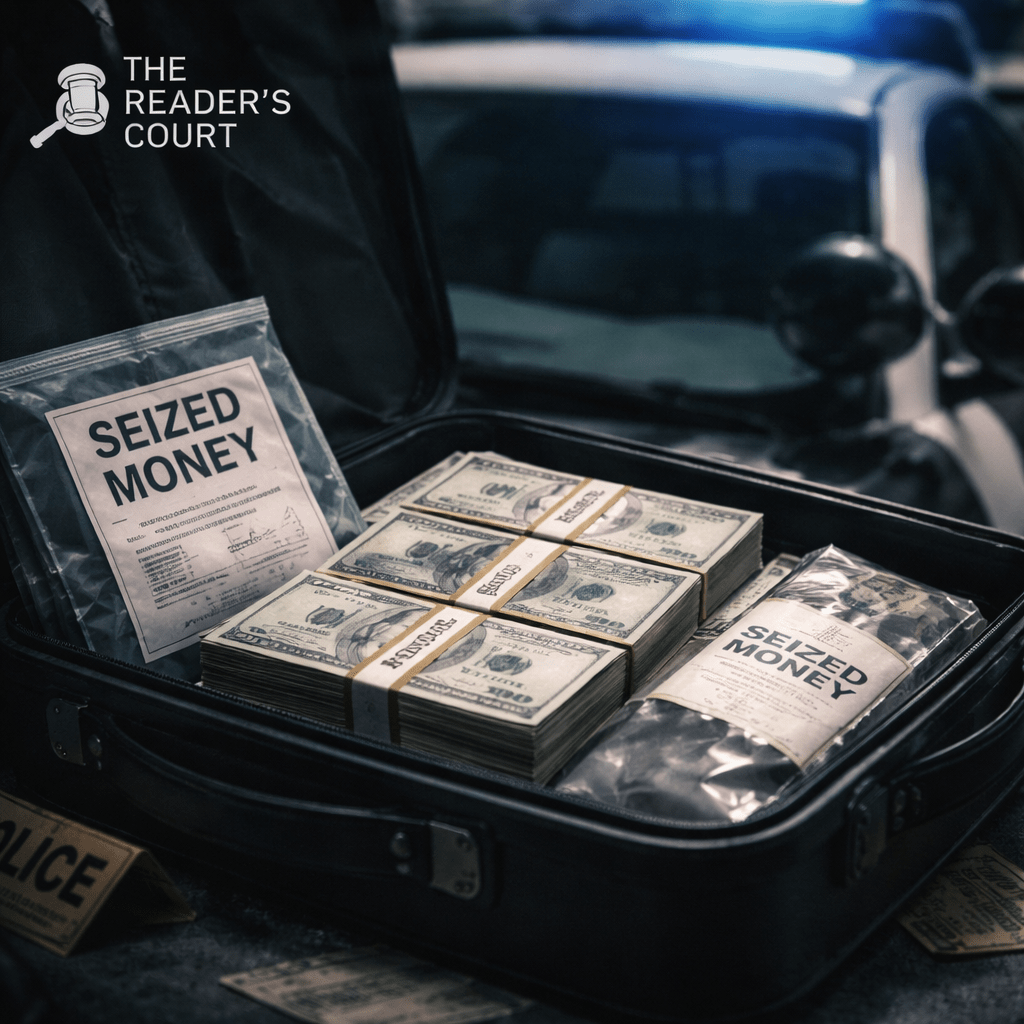
Calder took an evidence bag from the cruiser. The plastic crackled in the heat.
Whitaker stared at it. “What are you doing?”
“This money is being seized under civil forfeiture.”
Whitaker looked at him as if the words had arrived in the wrong language.
“You’re taking it.”
“It’s suspected to be connected to criminal activity.”
“You just searched the car.”
Calder said nothing.
“You found clothes.”
Silence.
“You found my wife.”
Whitaker nodded toward the photograph.
“You found the rest of my life in two suitcases and a paperback.”
Calder slid the envelope into the evidence bag and sealed it.
Whitaker took one step forward. Not threatening. Just human.
“I’m not under arrest?”
“No.”
“So what crime did I commit?”
“That will be determined later.”
The words struck him harder than if Calder had raised his voice.
Traffic kept moving. Pickups. Semis. A livestock truck carrying the sour smell of manure and heat. Nobody slowed. Nobody looked. The desert stretched away on both sides, immense enough to make private suffering seem administrative.
Whitaker rubbed a hand over his face and turned toward the road.
“That money is for the house,” he said quietly.
Calder gave no answer.
Whitaker looked back at him. His eyes were red now with effort.
“It was the first thing that was going to be mine outright in twenty-three years.”
The tow truck arrived in diesel noise and rattling chains. Calder signed the form, then handed Whitaker the receipt for the seized currency.
Whitaker stared at the slip of paper.
Forty-two thousand dollars had become a receipt.
“What happens now?” he asked.
“You can challenge the seizure in court.”
“How long does that take?”
“It depends.”
Whitaker folded the receipt with extraordinary care, as if it were fragile enough to tear under the weight of what it represented. He slipped it into the inside pocket of his jacket.
“And until then?”
Calder closed the trunk.
“Until then, the money stays in custody.”
Whitaker looked at the evidence bag on the hood of the cruiser. Forty-two thousand dollars. A house in Santa Fe. Light. A promise to a dying woman. Flattened into property held pending review.
Calder got back into the patrol car.
In the mirror he watched Whitaker standing beside the rental with one hand on the roof, as though he needed to steady the world nearest him. The tow truck driver was speaking, pointing, asking a practical question about destination. Whitaker did not seem to hear him.
When Calder pulled back onto the interstate, Whitaker was still there in the dust and heat, jacket over one arm, receipt in his pocket, watching the cruiser carry his future west.
The road to Santa Fe had not changed.
It had simply become longer than a man could walk.
Become a member of the Dossier. Support my writing.
The Question | The Money That Looked Guilty
Daniel Whitaker was not arrested.
No drugs were found in his car. No weapon. No warrant. No evidence of violence. No evidence that the money had come from any crime at all.
What the trooper found was cash, grief, and a man driving toward the last future he and his wife had planned together.
So if no crime had been proven, no charge had been filed, and no guilt had been established, what exactly gave the state the right to take his future anyway?
The Autopsy | The Money That Looked Guilty
What happened on that stretch of desert highway was not unusual. Civil asset forfeiture laws allow the state to seize property suspected of involvement in criminal activity even when the owner has not been charged with a crime.
Most citizens assume the law moves against a person. In forfeiture, it often moves against the property itself. A case may be filed not as a prosecution of Daniel Whitaker, but as a proceeding against the asset:
State v. $42,000 in U.S. Currency.
That structure matters because it shifts the burden. The state does not need to prove, at the moment of seizure, that Whitaker committed a crime. It only needs to assert that the money may be connected to unlawful activity. Once the property is taken, the owner must begin the process of getting it back.
In criminal law, the burden is supposed to remain with the state. Guilt must be proven before punishment follows. In forfeiture, that sequence is weakened. Property can be removed first. The fight over legitimacy comes later, and the owner must finance that fight himself.
That process is not neutral. It requires time, legal knowledge, filing deadlines, and money. For many people, contesting a seizure costs enough to make surrender rational. The system does not forbid resistance. It prices it.
The financial structure matters too. In many jurisdictions, forfeited assets or their proceeds can return to law enforcement agencies through budgets, equipment, training, or operational support. That creates an institutional interest in seizure that exists alongside the stated interest in public safety.
No officer has to invent evidence for the conflict to exist. No official has to be secretly dishonest. The incentive is already embedded in the design.
That is where the deeper change appears. Integrity, decency, and morality are no longer the first questions asked. The controlling questions become procedural: Was the seizure authorized? Was the paperwork filed? Was the property logged? Was the deadline met?
If those answers satisfy the statute, the system recognizes the action as legitimate even when no criminal conviction exists.
Daniel Whitaker’s grief does not alter that structure.
His intended use for the money does not alter it.
His lack of charges does not prevent it.
The law can still treat the seizure as proper.
The Reader’s Verdict | The Money That Looked Guilty
The traffic stop ended without an arrest.
Daniel Whitaker was allowed to return to the highway and continue west. No charges were filed. No court had yet examined the facts.
Only the money remained behind.
Forty-two thousand dollars now sits in custody, protected more securely than the man it was taken from.
The officer followed procedure.
The department followed statute.
The courts will follow the rules established for cases like this.
Nothing failed.
Everything worked exactly as the system was designed to work.
—Mark Bertrand
The Reader’s Court
When systems break people’s lives, the truth must be told.
Join the fight.
FILE YOUR VERDICT — Case 001 The Money That Looked Guilty
What is the right thing to do?
A) Restrain law enforcement from actions that don’t enforce laws. If no law was broken (and there’s no specific, articulable suspicion of a crime), the trooper should not pull the driver over.
B) End “consent fishing” in traffic stops. Law enforcement should not be allowed to ask for permission to search, nor order a person out of their vehicle, unless there is a clear safety reason or probable cause tied to a crime.
C) Restore public trust with a court-integrity package: binding ethics rules, mandatory recusal standards, financial transparency, and enforceable accountability. Judicial nominations must pass integrity screening.
Choose the verdict: A, B, or C.
Then comment: Why that one—and what’s the tradeoff you’re willing to accept?
What would you change tomorrow if you had the power?
The investigation does not end at the bottom of the page.
Explore Captured Reality Psychological Thrillers
These pages map the territory behind Mark Bertrand’s psychological thriller books: captured reality, corporate power, institutional pressure, algorithmic society, cultural dread, literary disorientation, and the old thriller tropes that no longer explain the world readers are living in.