Tag: Institutional Failure

Institutions are designed to create order, stability, and fairness. Yet history repeatedly shows how systems built for protection and oversight can fail when power, incentives, or bureaucracy overwhelm their original purpose. The articles in this section explore the points where institutions break down—when regulations fail, accountability disappears, or systems begin protecting themselves instead of the people they were meant to serve.

IMD Operations

IMD Operations File #004 | The Algorithm Denied His Life

A doctor prescribed the treatment. The algorithm denied his life. Not because it wouldn’t work. Because an algorithm decided the patient wasn’t worth the cost. In this IMD Operation, a family is forced to confront a machine that quietly decides who gets time… and who doesn’t. This is not a failure. This is how the system is designed to work. IMD intervenes. Integrity. Morality. Decency. IMD Operation complete. The machine will try again tomorrow. The story is fiction. The system is real. The investigation continues in The Reader’s Court.

When a father becomes a probability score, the system does not call it cruelty.

It calls it efficiency.

Not A Real Publisher LLC… production of IMD Operations.

File 004.

The Algorithm Denied His Life

IMD Operations in process.

The Algorithm Denied His Life

David Mercer was forty-nine years old, a husband, a father, and the kind of man who fixed things before they broke. He kept spare fuses in the garage, extra batteries in the kitchen drawer, and enough tools in the truck to rebuild a bad day before dinner. Then the scans came back, and none of that mattered.

The oncologist showed him and his wife the image on the wall and pointed to the shadow that had already learned how to spread.

There was one treatment left.

Expensive.
Aggressive.
Not guaranteed.
But real.

Real enough to fight for.

His wife, Elena, heard the word “chance” and built her whole body around it. She made binders. She tracked appointments. She argued with billing offices. She learned the language people learn only when the people they love are being translated into codes.

Their daughter, Sofia, listened from doorways and stairwells and the back seat of the car. Old enough to understand tone. Old enough to know when adults were lying with brave faces.

The request went to the insurer.

The doctor marked it urgent.
The chart was clear.
The treatment met the medical standard.
The family waited.

Then the answer came back.

Denied.

Not because the treatment was experimental.
Not because the doctor was unqualified.
Not because the hospital had made an error.

Denied because a risk model projected that David Mercer was statistically unlikely to survive long enough to justify the cost.

No human being said those words to his face.

They arrived polished. Sanitized. Hidden behind phrases like clinical pathway, utilization threshold, projected outcome alignment.

But the meaning was simple.

The treatment cost too much for a man the model had already begun to bury.

That night Elena stood in the kitchen with the denial letter in her hand while David sat at the table trying not to fold in on himself. Sofia watched from the hallway and saw something children should never see.

The moment when a family learns that insurance is not there to protect life.

It is there to price it.

Inside the system, the decision moved cleanly.

Claim received.
Model applied.
Risk score assigned.
Review bypassed.
Denial issued.

No raised voices.
No slammed doors.
No visible blood.

Just a quiet financial judgment made by a machine trained to speak the language of survival while serving the mathematics of loss.

The Financier watched from the architecture of policy and profit, where suffering only mattered when it disrupted quarterly certainty. To him, this was not a family. It was exposure. A liability curve. A cost event with names attached.

But somebody else was watching.

The Analyst found the denial pathway first.

The Coder traced the model logic through the insurer’s automated review stack and found the concealed weight buried under neutral language. Not quality of life. Not physician judgment. Not medical urgency.

Expected return on covered time.

The Operator found the bypass.

A human review channel existed.
The case qualified.
The machine had routed around it.

That was the design.

That was the lie.

IMD activated protocol.

Integrity.

Morality.

Decency.

The Analyst forced the buried variable into daylight.
The Coder opened the decision trail and mapped every suppressed checkpoint.
The Operator pushed the full record to the review authority, the provider escalation channel, and every node the system relied on remaining slow, silent, and compartmentalized.

By morning, the insurer had a problem it could not hide inside procedure.

The denial was reversed.

Officially, the case had been reevaluated.
Officially, additional documentation had been considered.
Officially, the system had functioned.

Unofficially, IMD had dragged a financial execution order back into human light.

David Mercer received the treatment.

Not a miracle.
Not a promise.
Not a rewritten future.

A chance.

The kind of chance the system had tried to reserve for people whose projected survival made better financial sense.

Elena sat beside him in the infusion room with both hands wrapped around his wrist as if time itself might still be negotiated by touch. Sofia stood on the other side trying to look brave enough for all three of them.

And somewhere behind the sealed language of compliance and reform, the model remained alive.

Waiting.
Learning.
Adjusting.

IMD Operation complete.

The machine will try again tomorrow.

The story is fiction.
The system is real.
The investigation continues in The Reader’s Court.

Connected evidence

Continue the Operation

The investigation does not end at the bottom of the page.
Connected evidence

Continue the Operation

The investigation does not end at the bottom of the page.
Authors Like

Authors Like Don DeLillo: When Language Becomes a Form of Power

The Violence Hidden Inside Calm Conversation

Readers who seek out authors like Don DeLillo are rarely looking for conventional suspense. They are drawn toward something colder and more unsettling: stories where systems quietly shape reality, where language manipulates perception, and where intelligent people slowly lose the ability to distinguish truth from the narratives protecting them. These novels understand that modern power rarely arrives screaming. It arrives calm, articulate, and absolutely certain of itself. That is the terrain Mark Bertrand enters—fiction where control operates beneath conversation itself and where the most dangerous force in the room is often the person speaking most reasonably.

Authors Like Don DeLillo image of the man at a desk gazing into thought when launge becomes a form of power

Authors Like Don DeLillo

DeLillo understands that dialogue is rarely innocent.

People speak to frame reality.
To redirect attention.
To establish hierarchy without openly declaring it.

A sentence becomes strategy.
A phrase becomes pressure.
A calm tone becomes dominance.

Bertrand operates with the same awareness.

His conversations are not exchanges of information. They are contests over perception itself. Every character enters the room trying to shape how reality will be interpreted by everyone else inside it.

That creates a very specific kind of tension.

Not physical danger.
Narrative danger.

The reader begins listening beneath the surface of every line, recognizing that what matters most is often what remains unspoken.

The Systems Already Decided Before the Characters Arrived

One of DeLillo’s great strengths is his understanding that modern life is governed by invisible systems long before individuals believe they are making independent choices.

Media.
Finance.
Technology.
Institutional power.
Cultural mythology.

Authors Like Don DeLillo characters move through structures already determining acceptable thought and acceptable behavior.

Bertrand builds pressure through the same recognition.

The danger in his work is never isolated to a single villain because the system itself has already normalized the behavior producing the harm. The people inside it simply learn how to survive within its logic.

Which is why the tension feels larger than personal conflict.

The reader senses something deeply uncomfortable:

The room was designed this way before the conversation even started.

Intelligence Does Not Save Anyone

DeLillo repeatedly exposes the weakness hidden inside intelligence. His characters are articulate, informed, culturally aware—and still incapable of escaping the systems shaping them.

Bertrand sharpens this even further.

In his work, intelligence often becomes the mechanism that prevents moral clarity. Characters explain too well. Rationalize too effectively. Interpret themselves into permission.

The more sophisticated the mind becomes, the more dangerous the self-deception becomes alongside it.

Which creates one of Bertrand’s strongest tensions:

People who believe they are seeing clearly while slowly disappearing inside their own narratives.

Language as Social Architecture

DeLillo’s fiction understands that language is not merely communication. It constructs the emotional architecture of modern life. Authors Like Don DeLillo:

Corporate speech.
Institutional speech.
Political speech.
Media speech.

The language itself begins determining what can be emotionally processed and what must remain abstract.

Bertrand enters the same territory from a sharper psychological angle.

His characters understand how carefully chosen language can sanitize reality. Harm becomes policy. Betrayal becomes necessity. Exploitation becomes professionalism. Moral compromise becomes maturity.

Nobody raises their voice.

That is what makes it terrifying.

The destruction occurs through calm justification delivered with composure and intelligence.

Controlled People Creating Controlled Realities

DeLillo’s characters often feel emotionally displaced from themselves, as though modern systems have replaced authentic experience with performance, simulation, and narrative management.

Bertrand pushes directly into that fracture.

Control becomes identity.
Presentation becomes survival.
Narrative becomes self-defense.

People begin constructing versions of themselves designed not to reveal truth, but to remain operational inside systems rewarding performance over honesty.

And once that process begins, intimacy itself becomes unstable.

Nobody fully trusts anyone because nobody fully reveals themselves anymore.

Atmosphere Built Through Psychological Recognition

DeLillo rarely depends on constant action to generate suspense. His tension comes from accumulation: patterns, contradictions, repeated phrases, emotional dislocation, systems pressing invisibly against ordinary life.

Bertrand operates in that same atmospheric register but with tighter pressure.

A glance lasts too long.
A sentence lands incorrectly.
A contradiction quietly surfaces.
A moment refuses to disappear from the reader’s mind.

The suspense builds through recognition rather than spectacle.

Readers begin understanding that the characters are trapped inside forces they can partially perceive but cannot fully control.

And often the characters themselves are the last people to recognize it.

The Emotional Cost of Institutional Reality

One of DeLillo’s defining themes is abstraction—the way institutions convert living human beings into manageable concepts.

Markets.
Audiences.
Consumers.
Data points.
Professional liabilities.

The individual slowly disappears beneath systems requiring simplification.

Bertrand brings that same anxiety into deeply personal territory.

His work repeatedly asks what happens when institutions become more important than human consequence. When image outranks morality. When procedural correctness replaces decency. When preserving structure matters more than preserving people.

The result is fiction where the emotional damage feels inseparable from the systems producing it.

Not accidental.
Structural.

Where the Comparison Becomes Exact

This is where The Vintner & The Novelist enters the same lineage unmistakably. From the Power and Privilege series.

The same conversational pressure.
The same awareness of invisible structures.
The same recognition that reality itself is often being managed inside the room.

But Bertrand intensifies the human confrontation.

Where DeLillo frequently observes cultural systems from a measured distance, Bertrand traps the reader inside the psychological cost of living within them. The pressure becomes more intimate. More morally immediate. More personally dangerous.

The systems are still there.

But now the reader must sit inside the moment where a human being decides whether to cooperate with them.

Modern Power No Longer Needs Villains

This may be the deepest connection between DeLillo and Bertrand.

Both understand that modern power rarely looks openly monstrous.

It looks educated.
Measured.
Professional.
Reasonable.

The people sustaining harmful systems are often intelligent individuals convinced they are behaving responsibly within the limits imposed upon them.

Which makes the moral tension infinitely more disturbing.

Nobody believes themselves guilty.
Everyone believes themselves necessary.

The Inevitable Next Read

Readers drawn to Don DeLillo will recognize the current immediately—the controlled dialogue, the awareness of hidden systems, the unsettling realization that language itself can manipulate moral reality.

But they will also feel the difference.

The Vintner and The Novelist by MARK BERTRAND COVER IMAGE OF A SPILLED WINE GLASS AND A VIVE WRAPPED PEN

Bertrand is less detached.
Less observational.
More willing to force collision.

Where DeLillo reveals the architecture of modern power, Bertrand pressures the reader directly inside the emotional and moral consequences of surviving within it.

And once that pressure begins, distance disappears.

The systems are no longer abstract.

They are sitting in the room, speaking calmly, explaining why everything happening is perfectly reasonable.

The Vintner & The Novelists

image button for purchasing the ebook
image button for purchasing the paperback
Connected evidence

Read Deeper

The investigation does not end at the bottom of the page.
IMD Operations

IMD Operations File #003 Who Controls the System

Who Controls the System

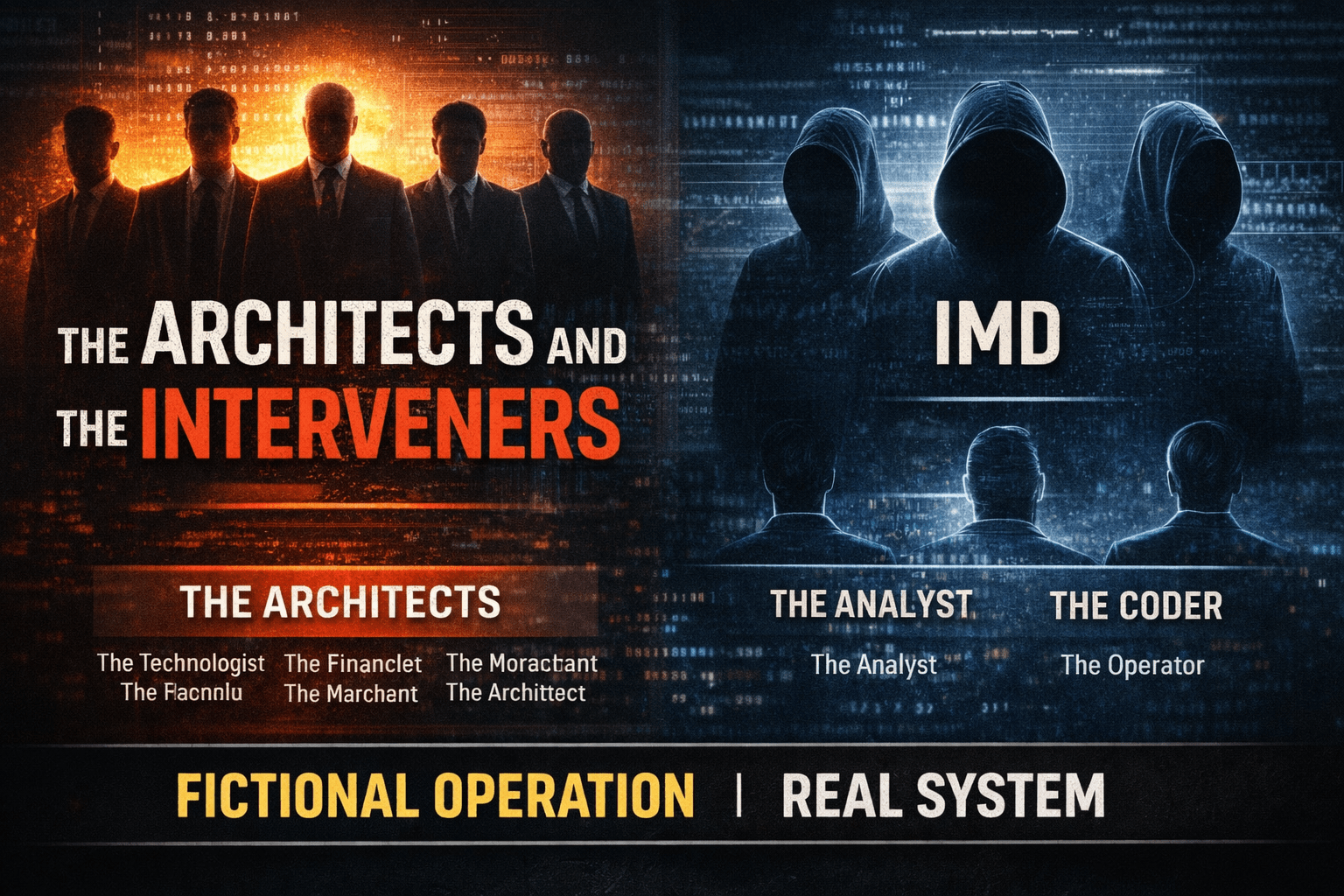
Systems do not run the modern world by accident. Someone built them. IMD Operations File 003 — Who Controls the System? introduces the hidden architects behind the algorithms that quietly shape housing, finance, healthcare, and modern economic systems. Across the world, automated systems now decide who receives an opportunity and who receives a denial. Loan approvals. Housing approvals. Insurance approvals. Behind these systems sit the architects. Five powerful figures who design the rules… and never live inside the consequences. But every machine has a weakness. And somewhere inside the system, a covert network has found it. They call themselves IMD. Integrity. Morality. Decency. Tonight… the war between the architects and the interveners begins.

Who Controls the System

who controls the system imd operations video file 003

A system does not need a villain to do harm.

It only needs alignment.

Not A Real Publisher LLC presents A production of IMD Operations.

Integrity.

Morality.

Decency.

File zero zero three.

The Alignment Protocol.

The public believes systems are separate.

Banks.

Corporations.

Governments.

Housing markets.

Financial markets.

Healthcare.

Each one claims independence.

Each one claims neutrality.

Each one claims the rules are being followed.

But IMD found the fracture.

The systems do not need to conspire when their incentives already point in the same direction.

A denial in one database becomes risk in another.

A risk score becomes exclusion.

Exclusion becomes profit.

Profit becomes policy.

Policy becomes the story.

And the story becomes truth.

This is how power hides.

Not behind one door.

Behind many.

Not inside one machine.

Inside all of them.

The Council does not need to meet.

The Technologist builds the logic.

The Financier controls the flow.

The Merchant sets the value.

The Architect shapes the environment.

The Narrator controls the story.

They do not need to coordinate.

The system does that for them.

IMD Operations in process.

The Analyst identifies the fracture.

The Coder enters the system.

Not to break it.

To trace it.

To follow one decision as it becomes many.

A credit decision.

A housing decision.

A pricing decision.

A medical decision.

A legal decision.

A public story.

The Operator waits for the moment of exposure.

Not loud.

Not public.

Precise.

The machine works because no one sees the whole machine.

So IMD makes the machine visible.

Banking records.

Corporate rules.

Government files.

Healthcare restrictions.

Market signals.

Narrative control.

The systems are separate only in name.

Under pressure, they move together.

Protocol activated.

Integrity.

Morality.

Decency.

The hidden structure appears.

The decision was never isolated.

The harm was never accidental.

The outcome was designed by alignment.

The public sees the map.

The machine loses invisibility.

For one night, power cannot pretend it is procedure.

For one night, the system cannot hide behind its own language.

IMD Operation complete. Who controls the system, villains.

The machine will try again tomorrow.

The story is fiction.

The system is real.

The investigation continues in The Reader’s Court.

Married Stupid
a Crime Thriller series

Start Here with SNODGRASS

snodgrass cover image for the novel. Snodgrass

SNODGRASS

Ebook purchase now image
audiobook purchase image
paperback purchase image

Related Articles

Best Crime Thriller Books for Readers Who Want More Than a Body Count
Captive Culture: How Greed Built the Modern Cage

Readers interested in psychological thriller books, institutional pressure, power and privilege, and cultural thriller should also explore:

Discover Books Like:

Books Like Damascus Station: When Espionage Turns Personal
Books Like Clockers or In the Woods

Find Authors Like:

Authors Like Don Winslow are not looking for cozy crime, clever puzzles, or harmless villains.
Authors Like Attica Locke: Control, Silence, and Power Beneath the Surface